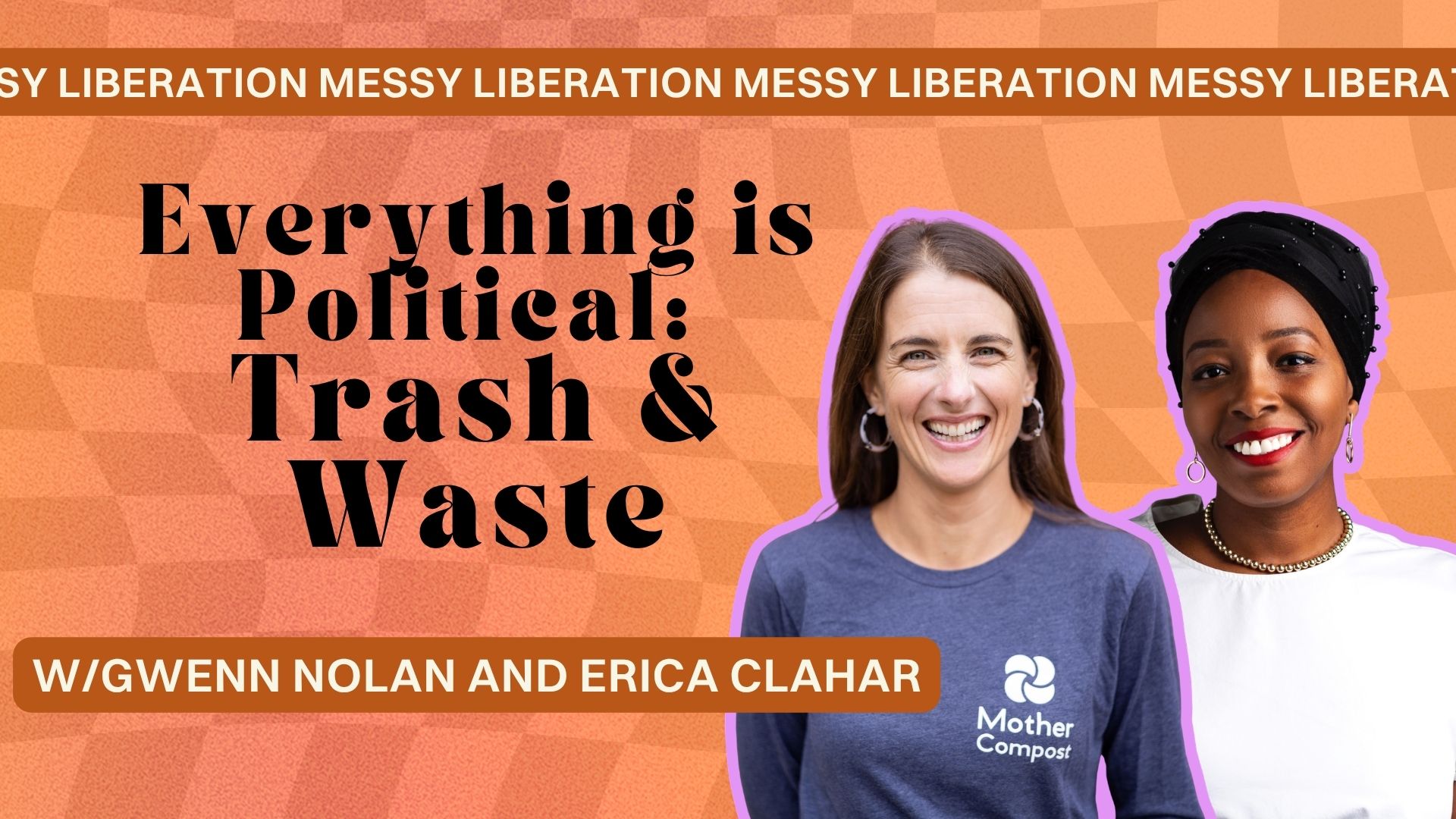
Everything Is Political series
We Throw Away 40% of Our Food While 40 Million People Go Hungry
June 15, 2026
This episode is for you if you’ve ever wondered what actually happens to your trash after it hits the curb — or if you want language for why food waste, hunger, and environmental racism are all the same issue.
Becky and Taina sit down with two guests doing this work on the ground: Erica Clahar, founder of the food-waste redistribution nonprofit Unifeeds, and Gwenn Nolan, founder of the composting company Mother Compost. The numbers alone are staggering — food waste is the single largest category of trash in America, roughly 140 billion pounds a year, or about 40% of our entire food supply, while an estimated 40 million people in the U.S. are food insecure.
From there, the conversation gets into how waste infrastructure itself is political: why wealthier neighborhoods get consistent trash pickup and real recycling options while Black and brown communities live closest to landfills and incinerators, why America exports its trash overseas only to get microplastics back in our food and clothes, and why “just recycle more” was never going to be enough to fix a system built on extraction in the first place.
About our guests
Erica Clahar is the executive director and founder of Unifeeds, an Atlanta-based food waste nonprofit that picks up surplus food and redistributes it to people who are food insecure.
Gwenn Nolan is the founder of Mother Compost, a food-excess recycling organization serving the greater Philadelphia region that has diverted roughly five million pounds of food waste from landfills and incinerators since launching seven years ago.
In This Episode, We Get Into:
- The staggering numbers: roughly 140 billion pounds of food wasted a year in the U.S. — about 40% of our entire food supply — while an estimated 40 million people are food insecure
- How both guests stumbled into this work by accident — an art event, a mountain of toddler food waste — rather than “spotting a market”
- The Good Samaritan Food Donation Act, and why fear of liability keeps usable food out of hungry people’s hands
- Composting as “the last line of defense” — recovering nutrients and water instead of losing them entirely
- Environmental racism in waste infrastructure: whose trash gets picked up on time, who gets public bins and real recycling access, and who doesn’t
- Incineration and landfill siting, and why the communities living closest to waste facilities are overwhelmingly Black and brown
- America’s practice of exporting trash overseas — and the microplastics that come back to us in our food and clothing
- Planned obsolescence and a culture trained to treat “new” as easier than “repaired”
- Reframing waste as a symptom of an extractive economic system, not a personal failure of willpower
- Resources mentioned: Unifeeds, Mother Compost, ReFED, Feeding America, the Institute for Local Self-Reliance, and the books Braiding Sweetgrass, Emergent Strategy, and The Serviceberry
Want more conversations like this — plus context, community, and upcoming events?
Join the email listNo spam. No hustle-y nonsense. Just real updates.